29er Class Technical Committee
Author: Fede Garcia
During 2025, the 29er Class conducted a focused testing program to evaluate the durability of the current jib design and identify improvements that extend sail life without affecting performance, safety, or class equality.
Wear Analysis:
The current jib shows two main wear areas:
- Leech: Flutter causes fatigue in the Mylar film. Increasing leech line tension reduces flutter but leads to distortion and accelerated wear.
- Lower panel: Repeated compression from the gennaker head creates creases and localized degradation.
Benchmark testing of two standard jibs showed failures after 57 hours and 41 hours respectively, confirming limited durability under intensive training and racing use.
Solutions Tested
Film thickness
Increasing the film thickness to 3.5 mm and 4 mm was evaluated. While thicker films add stiffness, the additional weight results in reduced performance, and testing has shown no significant improvement in overall lifespan compared to the current model.
Modified current model (actual stage)
- Leech improvements:
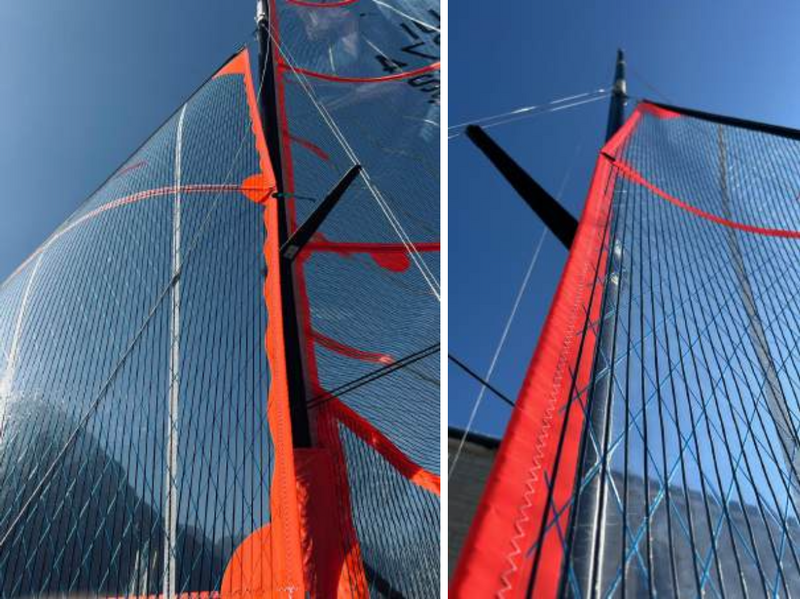
A slightly increased leech hollow, wave-pattern leech taping, tapered battens, and a dyneema leech line significantly improve leech stability and reduce flutter. - Bottom panels:
Development is underway on a new taffeta-reinforced material for the lower panels, aimed at reducing wear caused by repeated contact and compression at the gennaker tack point.
Conclusions
- Jib failures occur either at the leech or the lower panel, depending on wind and usage.
- The modified 3 mm jib delivers the highest performance with improved leech control, while further work is needed on lower panel durability
Testing continues to define the optimal long-term jib solution for the 29er class.
Modified 3mm Jib images:

tws=12kn

taping pattern vs standard jib